The Story
How this tradition took shape
Synthesized voice — not a recording.
From about 70 to 200 CE, Christians gathered in households. They lived in AntiochAntiochA great trading city of Syria, and the city of the bishop Ignatius. Its site is now Antakya, in today's Turkey.Place · pleiades.stoa.org and Syria, in the cities of western Asia Minor, and in Rome. Letters and travelers kept them joined as one. The last of the apostles' generation was passing, and no central body ruled these churches.
These churches held that legitimate teaching and practice must trace back to what the apostles had testified. Rome's letter to CorinthCorinthAn ancient Greek city in the Peloponnese, whose church removed some elders and drew Rome's letter. Its site is Archaia Korinthos, in Greece.Place · pleiades.stoa.org sets out a chain. God sent Christ, Christ sent the apostles, and the apostles appointed successors. IgnatiusIgnatiusBishop of Antioch. Seven letters in his name say he was marched under guard toward death in Rome. Their author and date are disputed.Person, a bishopbishopFrom the Greek episkopos, an overseer. Some churches had one bishop. Whether every church should have one was still argued.Term of Antioch, writes to several churches. He tells them to be subject to the bishop, as the apostles were subject to Christ.
The surviving letters give two different answers to who should lead once the apostles were gone. Ignatius's letters put one bishop at the center, with elderseldersLeaders who shared in ruling a community. In some churches they acted as a council. In others they served beside one overseer.Term and deaconsdeaconsPeople set apart to serve. In Justin's Rome they carried a share of the thanksgiving meal to members who could not come.Term beside him. One letter says the elders fit the bishop as strings fit a harp. In Rome, the surviving letters show a council of elders leading together. Ignatius addresses PolycarpPolycarpA church leader at Smyrna. His own letter to the Philippians survives, and his church told how he was put to death.Person, a church leader at SmyrnaSmyrnaAn ancient city of Asia Minor, now Izmir in today's Turkey. Polycarp led its church.Place · pleiades.stoa.org, as a bishop. Polycarp's own letter names him only beside the elders with him.
Letters held these scattered households together. The church at Rome wrote at length to Corinth, which had removed some of its elders from office. Rome argued that men who had served blamelessly should not have been removed. Seven surviving letters under Ignatius's name say he wrote them on a guarded journey toward Rome. Later, Polycarp sent the Philippians the letters of Ignatius that his church held, because they had asked for them.
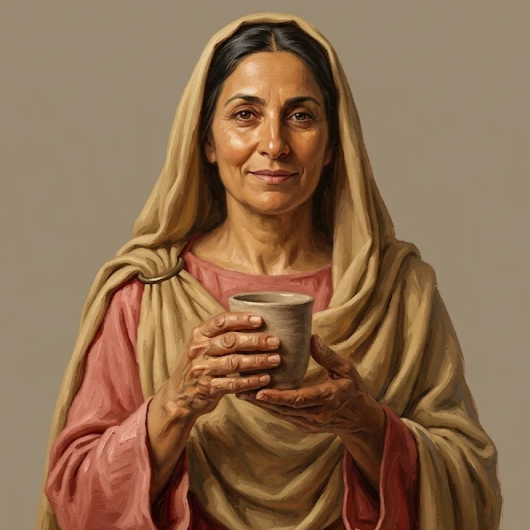
Giving thanks over bread and cupbread and cupThe thanksgiving meal, called eucharistia in Greek. Its prayers and order were not the same in every household.Term stood at the center of these gatherings, and its order changed from one household to the next. One community's manual, the DidacheDidacheA short teaching manual, likely from one community. One copy of 1056 keeps almost all of it. Scholars date it between about 50 and 150.Term, gives thanks over the cup before the bread. It tells no story of a supper or a betrayal. Ignatius says that only a thanksgiving the bishop leads, or entrusts to another, counts as proper. JustinJustinA philosopher who kept wearing his gown as a Christian. He described a Sunday gathering in a letter to the emperor. He died about 165.Person, a philosopher in Rome, describes a fuller Sunday gathering there.
The danger from the state was always there, but the actual incidents came and went. TacitusTacitusA Roman historian who despised Christians. Around 116, he wrote about the Great Fire of 64.Person, a Roman historian, reports that NeroNeroRoman emperor at the Great Fire of Rome in 64. Tacitus says rumor blamed him, and he turned the blame on Christians.Person blamed the Great Fire of Rome in 64 on a group the crowd called Christians. A great number, he says, were convicted and put to death. No source names one of them. About fifty years later, PlinyPlinyA Roman governor, not a Christian. He wrote to the emperor about Christians around 111 to 113.Person, the governor of Bithynia and PontusBithynia and PontusA Roman province on the Black Sea coast. Pliny governed it. Its lands lie in today's Turkey.Place · pleiades.stoa.org, wrote to the emperor TrajanTrajanThe Roman emperor who received Pliny's letter and answered it.Person for guidance. He found, in his words, "nothing but a depraved superstition that went too far." Trajan replied that Christians were not to be sought out, though those accused and convicted were to be punished.
Some communities read a death for the name as the completion of a life. Ignatius writes that he wants to be ground by the teeth of wild beasts, so that he may be found the pure bread of Christ. The church at Smyrna told how Polycarp died. Its letter says the community kept his bones in a fitting place. They hoped to gather there each year, as they were able, to keep the day of his death. The same letter names QuintusQuintusA man from Phrygia, named in the letter from Smyrna. He came forward for trial and then lost his nerve.Person, who came forward for trial and lost his nerve at the sight of the beasts. It says the gospel does not teach people to give themselves up. Only these two inside accounts survive, Ignatius's letters and Smyrna's letter, and both come from Antioch and Asia Minor.
By about 200, one bishop was becoming the dominant pattern, even in Rome. One modern scholar, Peter LampePeter LampeA modern scholar of the early church at Rome. He reads it as many small household groups that only slowly came under one bishop.Person, thinks Rome may not have had a single bishop before Victor, its bishop from 189 to 199. The texts of these churches do not say how or when Rome changed. From about 180, writers in other regions argued from an apostolic line they treated as already secure.