The Story
How this tradition took shape
Synthesized voice — not a recording.
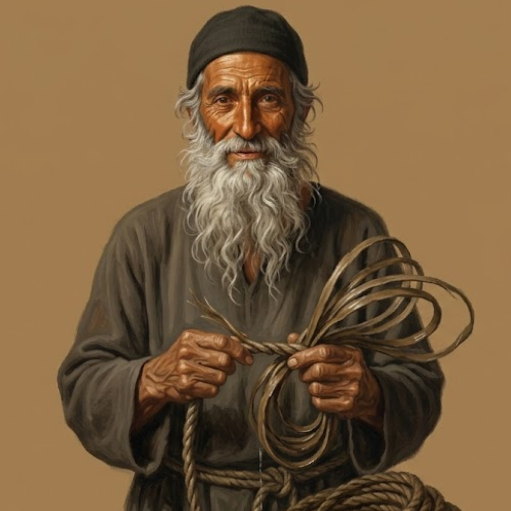
Between about 320 and 430, Christians in Egypt left their villages for the edge of the desert. The last empire-wide persecutionempire-wide persecutionThis was the last persecution of Christians across the whole Roman Empire. It began in 303 and ended between 311 and 313.Term had ended between 311 and 313. Until then, dying for the faith had been a way to offer everything. The tradition describes its own struggle in the language of that total confrontation. Now the fight was against demons, and the tempting thoughts they stirred in a person's mind. These Christians saw the leaving itself as the whole work of a Christian life.
AthanasiusAthanasiusBishop of Alexandria, about 296 to 373. He was not a desert monk, and he wrote about Antony from outside.Person, bishop of AlexandriaAlexandriaAn old port city in Egypt's Nile Delta. Alexander the Great founded it in 332 or 331 BCE. In Arabic it is called Iskandariya.Place · pleiades.stoa.org, wrote the Life of AntonyLife of AntonyAthanasius wrote this life of Antony between about 356 and 362. It is the most influential text about the movement. He wrote it from outside the movement.Term between about 356 and 362. The movement's founding portrait rests mostly on that one book, and scholars question how far its details are history. Athanasius says AntonyAntonyAn Egyptian monk, about 251 to 356. Nearly all that is known of him comes from the Life that Athanasius wrote.Person was about eighteen or twenty when his parents died. That was about 270. Soon after, he heard the Gospel read in church as if it had been read for him. He gave the family land to the villagers, and then he gave away the rest.
Antony then left in stages. He lived first near his village, then in an abandoned fort across the river. Last, he went to a mountain in the inner desert, three days' journey out. Athanasius gives a reason only for the last move. Crowds kept finding Antony, and he wanted quiet. By this account he stayed on that mountain for most of the rest of his life.
Not every monk lived alone. About 320, PachomiusPachomiusA monk who lived from about 292 to 346. He started a community of monks at Tabennesi. This is most often dated to about 320.Person gathered monks into a community at TabennesiTabennesiA place where Pachomius gathered his first monks. It is also spelled Tabennisis, and it lies in today's Egypt.Place · pleiades.stoa.org. PalladiusPalladiusA monk in Egypt about 388 to 399 who later became a bishop. He wrote the Lausiac History about 419 to 420.Person, a monk who lived in Egypt, wrote long after Pachomius died. He says an angel gave Pachomius a tablet with a rule on it. Tradition says the community had nine houses for men and two for women when he died in 346. It puts the members, roughly, in the low thousands.
Monks also lived in settlements such as NitriaNitriaA settlement of monks. Palladius says its church was in use only on Saturday and Sunday. Its site lies at Kom el-Barnugi, in today's Egypt.Place · pleiades.stoa.org, KelliaKelliaA settlement of monks' cells. More than 1,500 structures have been identified there. Its site lies at Kousour el-Robbeyat, in today's Egypt.Place · pleiades.stoa.org and ScetisScetisA valley in northern Egypt, now called Wadi el Natrun. Monks of the Coptic church settled there from late antiquity.Place · pleiades.stoa.org. They kept small cells and gathered once a week for worship. Authority worked in two ways. Hermits and the monks of the settlements looked to an elder called abba or ammaabba or ammaAbba is the title for a proven elder who is a man, and amma for a woman. Their word carried teaching weight, though they held no office.Term. This was a person whose wisdom had been proved. Elders held no office. In Pachomius's houses, a written rule and appointed offices governed. Even so, people remembered Pachomius himself as a father-elder. Both kinds of authority stood side by side through these years.
The desert had no fixed course of study. Discernment did that work. Called diakrisisdiakrisisDiscernment, the trained skill of judging rightly between thoughts, practices and counsels. It did the work that a course of study does elsewhere.Term, it was the skill of judging how much discipline a particular person could bear. In the collected sayingscollected sayingsShort words from an elder, each given to one person at one moment of need. Later compilers gathered them after about 430.Term of the elders, one pattern recurs. An eager newcomer asks an elder for an extreme practice, and the elder steers him toward something more moderate.
EvagriusEvagriusA monk who lived about 345 to 399. He settled at Kellia and died there in January 399.Person was a formally educated man. Basil of CaesareaBasil of CaesareaBishop of Caesarea. Palladius says he made Evagrius a reader.Person ordained him a reader, and Gregory of NazianzusGregory of NazianzusA bishop who, Palladius says, ordained Evagrius a deacon.Person made him a deacon. About 385 he settled at Kellia, where he lived for fourteen years. There he wrote a system for the struggle. It sorted the tempting thoughts, the logismoilogismoiThe unwanted thoughts and urges a monk fought. The list of eight kinds is Evagrius's own, and the wider movement did not share it.Term, into eight kinds. It also set out a path from practice to freedom from passion, and then to contemplation. The system belonged to him and his learned circle.
Evagrius died at Kellia in January 399. That year TheophilusTheophilusHe was bishop of Alexandria. His Easter letter of 399 began a quarrel. In 400, monks who followed Origen had to leave Egypt.Person, the bishop of Alexandria, sent an Easter letterEaster letterTheophilus's letter of 399. Cassian says it announced Easter and also took up the belief that God has a human body.Term saying that God has no human body. John CassianJohn CassianA monk who lived about 360 to 435. He wrote the Conferences in Gaul, decades after the events they tell of.Person, a monk who had lived at SceteSceteThis is the same place as Scetis, a valley in northern Egypt. It is now called Wadi el Natrun.Place · pleiades.stoa.org, wrote about it decades later. He reports that almost all the monks of Egypt took the letter badly. They felt it went against Scripture, which they took to give God a human form. Theophilus then reversed course, for reasons scholars dispute. He campaigned against the followers of the teacher OrigenOrigenA Christian teacher in Alexandria, who lived about 185 to 253. His book On First Principles set out the ideas behind the quarrel.Person.
In 400, a council at Alexandriacouncil at AlexandriaA church council held in 400. It condemned Origen and the monks who followed him.Council condemned Origen and the monks who followed him. That year four monk leaders called the Tall BrothersTall BrothersFour brothers who led monasteries in Egypt. The historian Socrates says people called them the Tall Monks, for their height.Person, and others among them, had to leave Egypt. The circle around Evagrius was broken up.